

CCTV Privacy Notice
Administrative Centre Petržalka
Röntgenova 26 and 28, Bratislava
Introduction
This notice explains how PUKMP s.r.o., with its registered office at Röntgenova 26, 851 01 Bratislava, Slovakia, company ID No. 31 368 638, registered in the Commercial Register of the Bratislava III Municipal Court, Section Sro, entry No. 6661/B, uses its CCTV system to process the personal data of individuals in the monitored areas of the Administrative Centre Petržalka at Röntgenova 26 and Röntgenova 28, Bratislava, Slovakia. It also explains how the company handles and protects that personal data.
The purpose of this CCTV Privacy Notice (the “Notice”) is to inform you how PUKMP collects and processes your personal data when operating its CCTV system, what data protection rights you have and how to exercise them.
This Notice has been prepared in accordance with Regulation (EU) 2016/679 of the European Parliament and of the Council of 27 April 2016 on the protection of natural persons with regard to the processing of personal data and on the free movement of such data, and repealing Directive 95/46/EC (the “GDPR”). It informs data subjects about the processing of their personal data, their rights, and the manner and scope of the processing.
Data controller
The controller of the personal data processed by the CCTV system is PUKMP s.r.o., with its registered office at Röntgenova 26, 851 01 Bratislava, Slovakia, company ID No. 31 368 638, registered in the Commercial Register of the Bratislava III Municipal Court, Section Sro, entry No. 6661/B:
(referred to below as the “controller”).
The controller is also responsible for the technical administration of the CCTV system.
The private security service responsible for protecting the Administrative Centre Petržalka also uses the CCTV system. Its staff have online access to the live camera feeds through monitors at the reception desks of both buildings. The security service is contractually required to protect the confidentiality of the personal data displayed and to take appropriate steps to prevent unauthorised access, in particular to prevent third parties from recording the camera feeds displayed on the monitors.
Personal data processed, purposes and legal basis
The CCTV system processes video footage of individuals in the monitored areas of the Administrative Centre Petržalka (each a “data subject”) to the extent that the footage enables those individuals to be identified directly or indirectly.
The controller does not intend to deliberately collect or process special categories of personal data under Article 9 of the GDPR through the CCTV system. Examples include data revealing racial or ethnic origin and data concerning health, including data from which a person's disability could be inferred.
The controller processes personal data through the CCTV system on the basis of its legitimate interest under Article 6(1)(f) of the GDPR in protecting people and property and safeguarding its other legally protected interests.
The main purpose of processing personal data obtained through the CCTV system is to protect the controller's property. In particular, the system is used to prevent, detect and investigate conduct that could result in property damage, theft, vandalism or threats to personal safety. Where justified, CCTV footage may be used as evidence when investigating incidents and may be disclosed to the competent public authorities where the legal conditions are met.
CCTV system and footage retention
The Administrative Centre Petržalka CCTV system consists of 36 cameras located throughout the monitored areas of the site.
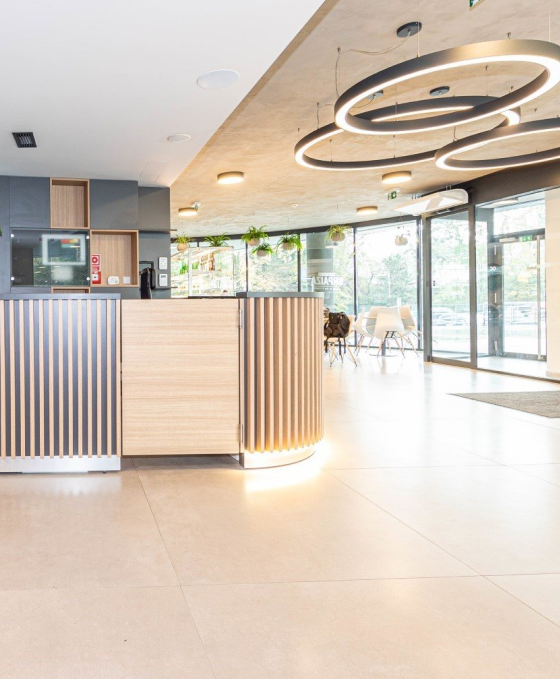
The CCTV system monitors outdoor areas of the Administrative Centre Petržalka that are owned or managed by the controller and accessible to the public, tenants and other visitors, including parking spaces. It also monitors the publicly accessible indoor reception areas of both buildings and the indoor garages accessible to tenants, their visitors and the controller's suppliers. Cameras do not cover places intended exclusively for private activities where people can reasonably expect greater privacy, particularly areas used for personal hygiene or other intimate activities.
The entrances to monitored areas display the first layer of information about the operation of the CCTV system. These signs provide basic information about the processing of personal data and a link to this Notice. Data subjects can find the full information about the processing of personal data through the CCTV system in this Notice.
The cameras capture images in colour and operate continuously on the basis of motion detection. The CCTV system does not record audio. Personal data contained in CCTV footage is kept on the recording device for a maximum of seven calendar days. This period gives the controller a reasonable amount of time to detect, investigate and assess security incidents or other events relevant to the protection of people and property.
At the end of this period, CCTV footage is automatically deleted by being progressively overwritten in a loop, unless a specific portion needs to be kept longer for one of the reasons below. Specific portions of footage may be kept beyond the standard seven-day period where necessary to establish, exercise or defend the controller's legal claims or protect its other legitimate interests. Extended retention is limited to the portions of footage needed and the time necessary to achieve the relevant purpose. Only authorised persons may access this footage, which is disclosed to third parties only in accordance with applicable law.
Data security
The controller has introduced and maintains appropriate technical and organisational measures, internal controls and information security processes in line with best business practice appropriate to the potential risk to data subjects. The controller also takes account of technological developments to protect personal data against accidental loss, destruction, alteration, unauthorised disclosure or access. Authorised persons may access CCTV footage only in justified cases, and every instance of access is properly logged.
These measures may include appropriate steps to ensure accountability among employees who have access to personal data, as well as staff training.
Data subject rights
Under the GDPR and subject to the conditions laid down by applicable law, a data subject whose personal data is processed through the CCTV system has, in particular, the following rights:
- Right to be informed – the right to obtain information about the processing of your personal data to the extent provided for by the GDPR.
- Right of access – the right to obtain confirmation as to whether personal data concerning you is being processed and, if so, to access it in accordance with the GDPR.
- Right to rectification – the right to request the correction of inaccurate personal data or the completion of incomplete personal data under Article 16 of the GDPR.
- Right to erasure – the right to request the deletion of personal data if the conditions under Article 17 of the GDPR are met.
- Right to restriction of processing – the right to request that processing be restricted in the cases set out in Article 18 of the GDPR.
- Right to object – the right to object, on grounds relating to your particular situation, to processing based on the controller's legitimate interest under Article 6(1)(f) of the GDPR.
- Right to lodge a complaint with a supervisory authority – the right to contact the competent supervisory authority if you believe the processing of your personal data infringes the GDPR or other applicable laws.
The supervisory authority in Slovakia is:
Exercising your rights
You can exercise your rights relating to the processing of personal data by contacting the controller using the contact details in this Notice. The controller handles requests in accordance with the GDPR and applicable law.
Where justified, the controller may ask for additional information to verify the identity of the person making a request, particularly where the controller has reasonable doubts about their identity. Verification must be proportionate to the circumstances and must not result in unjustified collection of additional personal data.